Ireland’s construction industry remains one of the country’s important sources of employment in 2026, supported by continued investment in housing, infrastructure, commercial development, utilities and major capital projects.
For job seekers, the sector offers opportunities ranging from entry-level labouring and skilled trades to engineering, quantity surveying, site management and construction project management.
It is also an important sector for foreign workers. Several construction-related professional occupations are included on Ireland’s current Critical Skills Occupations List, including Site Manager, Construction Project Manager, Construction Planner/Scheduler and Commercial Manager.
Current JobsIreland listings demonstrate the breadth of the market. Recent vacancies have included civil engineers, quantity surveyors, MEICA project managers, electrical engineers, commissioning engineers, plant fitters, construction-materials technicians, electricians and skilled construction workers.
This guide explains the main construction jobs available in Ireland in 2026, expected salary levels, qualifications and experience employers look for, opportunities for foreign workers, employment-permit requirements and how to find legitimate construction jobs.
Why Construction Jobs Are in Demand in Ireland
Ireland continues to require substantial construction activity across several areas:
- Residential housing
- Apartment developments
- Commercial buildings
- Roads
- Bridges
- Water infrastructure
- Renewable-energy projects
- Data centres
- Industrial facilities
- Pharmaceutical facilities
- Hospitals
- Schools
- Public infrastructure
- Utilities
- Manufacturing facilities
Recruitment specialist Collins McNicholas reports that ongoing investment in residential development, infrastructure and capital projects continues to support demand for experienced construction professionals in Ireland. Its 2026 salary research is based on data from more than 6,000 candidates and over 400 successful placements made between January and March 2026.
This creates opportunities at multiple levels.
Someone without extensive professional qualifications may find work as a labourer or construction operative, while someone with an engineering degree and several years of experience can target civil engineering, project management or site-management positions.
Types of Construction Jobs in Ireland
The Irish construction industry is much larger than builders and general labourers.
Some of the major categories include:
- Construction labourers
- General operatives
- Carpenters
- Bricklayers
- Plasterers
- Plumbers
- Electricians
- Steel fixers
- Groundworkers
- Plant operators
- HGV drivers
- Plant fitters
- Site supervisors
- Site managers
- Construction managers
- Civil engineers
- Structural engineers
- Mechanical engineers
- Electrical engineers
- Quantity surveyors
- Commercial managers
- Construction planners
- Construction schedulers
- BIM professionals
- Project managers
- Health and safety professionals
- Building-services professionals
The best occupation for you depends on your qualifications, experience, professional certification and right to work in Ireland.
1. Construction Labourer
Construction labouring is one of the more accessible ways to enter the sector.
Typical responsibilities can include:
- Moving materials
- Preparing work areas
- Cleaning construction sites
- Assisting tradespeople
- Loading and unloading materials
- Basic site preparation
- Following health and safety procedures
- Supporting construction teams
A labourer normally does not need a university degree.
However, employers will expect:
- Physical fitness
- Reliability
- Safety awareness
- Ability to follow instructions
- Ability to work outdoors
- Basic communication skills
For someone already legally entitled to work in Ireland, construction labouring can provide an entry point into the industry.
For someone outside the EEA seeking an employment permit, however, the immigration situation is much more restrictive. You should never assume that an entry-level construction job automatically qualifies for sponsorship.
2. General Construction Operative
General construction operatives can work across different areas of a project.
Duties may include:
- Site preparation
- Groundwork
- Material handling
- Concrete work
- Assisting trades
- Basic construction tasks
- Site maintenance
Experience can eventually lead to more specialised construction positions.
A worker might progress from:
General operative → skilled operative → trade specialist → supervisor → site manager
This makes construction attractive for people who want to develop a career rather than simply find temporary work.
3. Carpenter
Carpenters are needed for:
- Structural timber work
- Doors
- Frames
- Roof structures
- Interior fit-outs
- Formwork
- Renovation projects
- Commercial construction
Experienced carpenters can command significantly more than entry-level labourers, especially when they have specialist skills and can work independently.
Useful qualifications include recognised trade training and apprenticeships.
4. Electrician
Electricians are required in both traditional construction and large industrial projects.
They may work on:
- Residential buildings
- Commercial properties
- Industrial facilities
- Manufacturing plants
- Data centres
- Renewable-energy projects
- Building-services installations
Recent JobsIreland construction listings included industrial electrician positions in Kildare and Kilkenny.
Industrial electrical experience can be particularly valuable because large manufacturing and infrastructure projects require specialised electrical skills.
5. Plumber
Construction plumbers work on:
- Water systems
- Heating systems
- Drainage
- Sanitary systems
- Commercial plumbing
- Industrial systems
- Building services
Experienced plumbers may work for construction contractors, mechanical contractors, facilities companies or specialist subcontractors.
International plumbers should investigate whether their qualifications and experience are recognised for the specific job they are targeting.
6. Bricklayer
Bricklayers remain important for residential and commercial construction.
Typical work includes:
- Brick walls
- Blockwork
- Structural masonry
- Extensions
- Housing developments
- Commercial buildings
A recognised trade qualification and demonstrable experience can improve employment prospects.
7. Groundworker
Groundworkers are involved in the early stages of construction.
Typical responsibilities include:
- Excavation
- Drainage
- Foundations
- Concrete preparation
- Pipe installation
- Road preparation
- Site preparation
- Kerbing
Current JobsIreland construction listings have included pipe layers and groundworkers in civil-engineering projects.
Groundworkers with experience operating machinery or working on major civil projects can become particularly valuable.
8. Plant Operator
Construction projects use heavy machinery for excavation, lifting and material handling.
Potential roles include:
- Excavator operator
- Telehandler operator
- Crane operator
- Forklift operator
- Dumper operator
- Roller operator
- Plant operator
Employers generally expect appropriate training, certification and experience for the equipment being operated.
Safety is extremely important because heavy machinery creates significant workplace risks.
9. Construction Plant Fitter
Plant fitters maintain and repair construction machinery.
Responsibilities may include:
- Diagnosing mechanical faults
- Servicing machinery
- Repairing hydraulic systems
- Maintaining engines
- Electrical troubleshooting
- Preventive maintenance
- Emergency repairs
Current JobsIreland listings have included construction plant fitter positions.
This can be a strong option for people with mechanical or heavy-equipment experience.
10. Civil Engineer
Civil engineering is one of the more professional routes into Ireland’s construction sector.
Civil engineers may work on:
- Roads
- Bridges
- Drainage
- Water infrastructure
- Buildings
- Rail projects
- Utilities
- Earthworks
- Infrastructure development
Current JobsIreland listings include civil engineering opportunities, including a Civil Engineer internship/placement in County Galway and a Civils Design Engineer position in Loughrea, County Galway.
A relevant engineering degree is normally required for professional civil-engineering positions.
11. Structural Engineer
Structural engineers design and assess structures to ensure they are safe and fit for purpose.
They can work on:
- Buildings
- Bridges
- Industrial structures
- Residential developments
- Commercial properties
- Infrastructure
Structural engineering is a specialist professional field and can offer strong salaries to experienced engineers.
12. Mechanical Engineer
Mechanical engineers are particularly important on:
- Industrial projects
- Pharmaceutical facilities
- Manufacturing plants
- Data centres
- Building services
- Energy projects
- Mechanical installations
Current JobsIreland construction listings include mechanical and MEICA-related roles.
13. Electrical Engineer
Electrical engineers work on the design, installation and commissioning of electrical systems.
Potential projects include:
- Industrial plants
- Data centres
- Pharmaceutical facilities
- Commercial buildings
- Renewable energy
- Utilities
- Manufacturing
Recent JobsIreland listings included an Electrical Engineer position in the industrial/Leinster construction sector.
14. Quantity Surveyor
Quantity surveyors are responsible for the commercial and financial side of construction projects.
Their responsibilities can include:
- Cost estimation
- Tendering
- Procurement
- Budget management
- Contract administration
- Valuations
- Variations
- Subcontractor payments
- Cost forecasting
- Final accounts
Quantity surveying is an important professional career in Ireland.
Recent JobsIreland listings have included quantity-surveyor positions and placements.
A previous Irish vacancy for a Quantity Surveyor advertised a salary range of €36,000–€44,000 for a 39-hour week, illustrating how compensation can vary substantially according to experience and employer.
15. Construction Planner / Scheduler
Planning is increasingly important on large construction projects.
Construction planners and schedulers may be responsible for:
- Project schedules
- Resource planning
- Programme development
- Progress tracking
- Critical-path analysis
- Contractor coordination
- Reporting
- Project forecasting
This is especially important on major infrastructure and industrial projects.
Importantly for foreign workers, Construction Project Managers / Construction Planner / Construction Scheduler are included on Ireland’s current Critical Skills Occupations List.
16. Site Manager
Site managers oversee day-to-day construction operations.
Their responsibilities may include:
- Managing workers
- Coordinating subcontractors
- Monitoring progress
- Health and safety
- Quality control
- Materials
- Site documentation
- Programme management
- Client communication
- Ensuring work meets specifications
Site Manager is currently included on Ireland’s Critical Skills Occupations List.
This is particularly significant for experienced overseas construction professionals.
17. Construction Project Manager
Project managers have responsibility for the overall delivery of construction projects.
They may manage:
- Budget
- Programme
- Contractors
- Consultants
- Procurement
- Risk
- Quality
- Health and safety
- Client relationships
Construction project management is currently included on Ireland’s Critical Skills Occupations List.
For an experienced international construction professional, this can be one of the more attractive Irish employment-permit pathways.
18. Commercial Manager
Commercial managers oversee the financial and contractual aspects of large construction projects.
Their work may include:
- Contract management
- Cost control
- Commercial negotiations
- Procurement
- Claims
- Variations
- Subcontractor management
- Financial reporting
Commercial Manager is currently listed under the construction-related Critical Skills occupations.
Construction Salary Expectations in Ireland
Construction salaries vary enormously.
The biggest factors include:
- Profession
- Experience
- Location
- Project size
- Employer
- Qualifications
- Management responsibility
- Specialist skills
- Overtime
- Contract type
The 2026 Collins McNicholas construction salary guide reports continued demand for experienced quantity surveyors, project managers, site managers and engineers across Ireland.
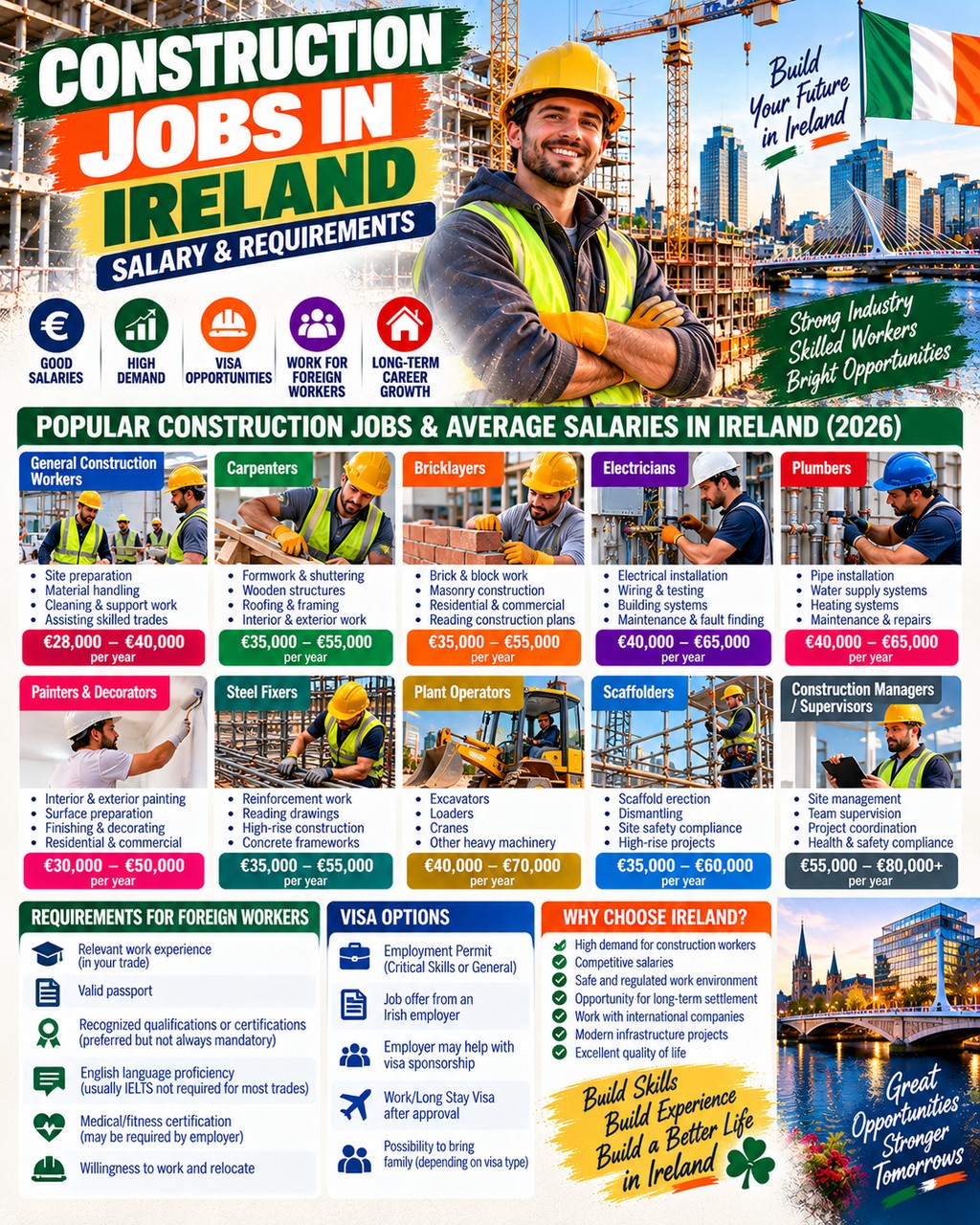
Indicative market ranges can look approximately like this:
| Construction Job | Indicative Annual Salary |
|---|---|
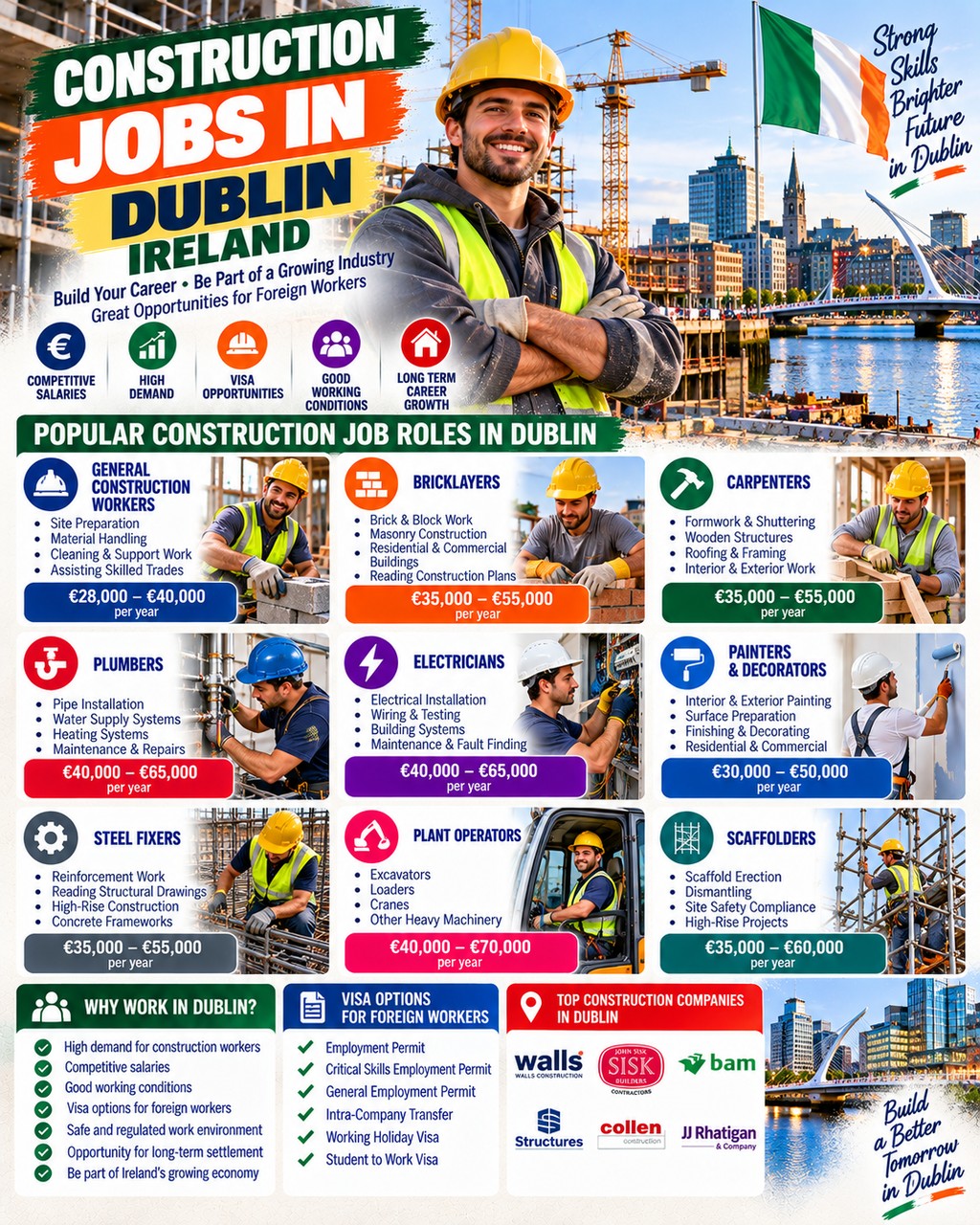
| Construction Labourer | €30,000–€40,000 |
| Skilled Construction Worker | €35,000–€50,000+ |
| Carpenter | €35,000–€55,000+ |
| Electrician | €40,000–€65,000+ |
| Plumber | €40,000–€60,000+ |
| Groundworker | €35,000–€50,000+ |
| Plant Operator | €35,000–€55,000+ |
| Civil Engineer | €45,000–€75,000+ |
| Quantity Surveyor | €45,000–€85,000+ |
| Site Manager | €60,000–€100,000+ |
| Project Manager | €70,000–€110,000+ |
| Commercial Manager | €75,000–€120,000+ |
| Senior Construction Manager | €80,000–€130,000+ |
These are indicative market ranges, not guaranteed salaries. Actual offers can be lower or higher depending on experience, employer, region, project type and benefits.
For international workers, the salary must also satisfy the relevant employment-permit requirements where a permit is required.
Construction Salaries: Dublin vs Regional Ireland
Dublin generally offers some of the country’s strongest salary opportunities, particularly for:
- Project managers
- Site managers
- Quantity surveyors
- Engineers
- Commercial managers
- Construction planners
However, regional Ireland should not be ignored.
Major construction employment markets include:
Dublin
- Housing
- Commercial buildings
- Infrastructure
- Data centres
- Public projects
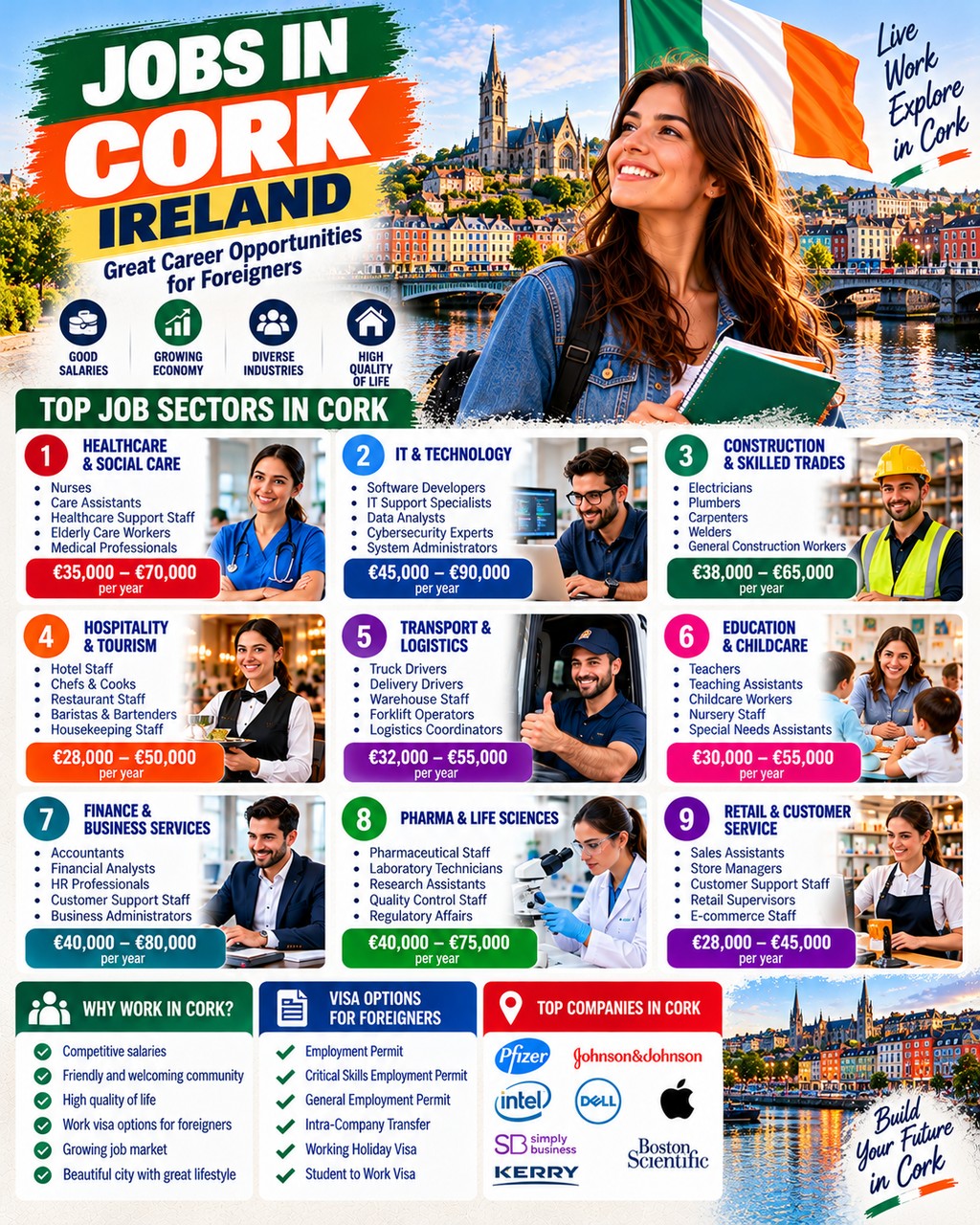
Cork
- Pharmaceuticals
- Industrial projects
- Manufacturing
- Infrastructure
- Housing
Galway
- Medical devices
- Industrial construction
- Housing
- Infrastructure
Limerick
- Manufacturing
- Pharmaceuticals
- Technology
- Infrastructure
Kildare
- Industrial
- Logistics
- Housing
- Infrastructure
Meath
- Housing
- Infrastructure
- Industrial projects
Current JobsIreland listings show construction vacancies across counties including Galway, Kildare, Meath, Kilkenny, Cork, Louth and Dublin.
Requirements for Construction Jobs in Ireland
Requirements depend heavily on the position.
Entry-Level Labourer
May require:
- Basic construction experience
- Safety awareness
- Physical fitness
- Reliability
- Ability to follow instructions
Skilled Trades
Usually require:
- Trade qualification
- Relevant experience
- Safety training
- Appropriate certification
Engineer
Usually requires:
- Engineering degree
- Relevant experience
- Technical skills
- Knowledge of Irish/EU standards where applicable
Quantity Surveyor
Usually requires:
- Quantity surveying degree or equivalent
- Commercial construction experience
- Contract knowledge
- Cost-management experience
Site Manager
Usually requires:
- Significant construction experience
- Supervisory experience
- Health and safety knowledge
- Project-management skills
- Leadership ability
Project Manager
Usually requires:
- Relevant degree or professional qualification
- Several years of construction experience
- Project-management experience
- Budget and programme-management skills
Safe Pass and Construction Site Requirements
People working on Irish construction sites should understand the country’s construction-safety requirements.
Safe Pass is an important safety-awareness requirement for people working on construction sites in Ireland.
Depending on the occupation, additional training may be required, such as:
- Manual handling
- Working at heights
- Abrasive wheels
- MEWP training
- Plant-operation certification
- First aid
- Other occupation-specific safety training
Employers may specify particular certificates in their job advertisements.
Foreign workers should not assume that a safety certificate from another country is automatically equivalent to an Irish requirement.
Construction Jobs for Foreign Workers
Ireland can be attractive for international construction professionals because several construction occupations are currently included on the Critical Skills Occupations List.
The current list includes:
- Site Manager
- Construction Project Manager
- Construction Planner
- Construction Scheduler
- Commercial Manager
- Civil engineering-related occupations
- Structural engineering roles
- Mechanical engineering roles
- Electrical engineering roles
- Certain specialist engineering positions
This is particularly important for experienced professionals.
A foreign worker with ten years of experience as a construction project manager has a very different immigration profile from someone applying for a general labourer position.
Ireland Employment Permit Salary Requirements
For 2026, the standard minimum annual remuneration for a General Employment Permit is:
€36,605
The minimum for a Critical Skills Employment Permit with a relevant degree is:
€40,909
For eligible Critical Skills occupations without a relevant degree, the threshold is:
€68,911
There is also a Critical Skills graduate threshold of:
€36,849
These figures are employment-permit thresholds, not average construction salaries.
A job paying €40,000 does not automatically qualify for a Critical Skills permit just because it is close to the salary threshold. The occupation itself must also meet the relevant criteria.
How the Critical Skills Employment Permit Works
The Critical Skills Employment Permit is designed for highly skilled occupations where Ireland has identified shortages.
One major advantage is that a Labour Market Needs Test is not required for Critical Skills occupations.
For eligible construction professionals, this can make the immigration route more attractive.
The permit generally requires:
- Eligible occupation
- Relevant qualifications, skills and experience
- Eligible salary
- Bona-fide Irish employer
- Employment offer of at least two years
The Department states that an application should generally be received at least 12 weeks before the proposed employment start date.
Can a Construction Labourer Get an Irish Work Permit?
This is where applicants need to be careful.
Ireland’s employment-permit system does not mean that every construction job can be sponsored.
Some lower-skilled construction occupations may be ineligible for employment permits, while specific occupations or skills have exceptions or different rules.
Therefore, someone outside the EEA should not simply search for:
“Construction jobs with visa sponsorship Ireland.”
Instead, search for the exact occupation:
“Site Manager Ireland employment permit”
or:
“Construction Planner Ireland Critical Skills”
or:
“Civil Engineer Ireland Critical Skills”
Then verify the occupation against the current official Irish employment-permit lists.
Can Pakistani Construction Workers Get Jobs in Ireland?
Yes, potentially—but the route depends on the occupation.
A Pakistani:
- Civil engineer
- Structural engineer
- Electrical engineer
- Mechanical engineer
- Site manager
- Construction project manager
- Quantity surveyor
- Construction planner
may have more relevant opportunities than someone applying for an ordinary labouring position.
The first group contains occupations that can potentially fit Ireland’s skills-based employment-permit system, depending on the exact job and requirements.
For Pakistani tradespeople, the situation needs to be checked individually because having extensive construction experience does not automatically make an occupation eligible for an employment permit.
What Qualifications Are Valuable?
For professional construction jobs, the following can be particularly valuable:
Engineering
- Civil engineering degree
- Structural engineering degree
- Mechanical engineering degree
- Electrical engineering degree
Commercial
- Quantity surveying qualification
- Commercial management experience
- Contract-management experience
Project Management
- Construction project-management experience
- Project-management certification
- Planning/scheduling experience
Technical
- BIM
- AutoCAD
- Revit
- Primavera P6
- MS Project
- Civil 3D
- Quantity surveying software
Safety
- Health and safety qualifications
- Construction safety training
- Risk assessment experience
Skills That Can Increase Your Salary
If you want to move from a basic construction salary into higher-paying positions, specialist skills can make a major difference.
BIM
Building Information Modelling is increasingly important in large construction projects.
Useful software includes:
- Revit
- Navisworks
- Civil 3D
Planning
Learn:
- Primavera P6
- MS Project
- Programme management
- Critical-path analysis
Quantity Surveying
Develop:
- Cost planning
- Procurement
- Contract administration
- Valuations
- Variations
- Final accounts
Commercial Management
Learn:
- NEC contracts
- FIDIC
- Claims
- Variations
- Procurement
- Cost control
Digital Construction
Experience with construction technology can help professionals move into specialist roles.
How to Find Construction Jobs in Ireland
One of the best starting points is JobsIreland, Ireland’s national employment service.
Recent JobsIreland construction searches have shown dozens of vacancies across different occupations and regions, including engineering, quantity surveying, project management, electrical, mechanical and skilled construction roles.
Other useful sources include:
- JobsIreland
- EURES
- IrishJobs
- Indeed Ireland
- Construction recruitment agencies
- Direct company career pages
For foreign workers, always check whether the employer is genuinely offering an eligible position and whether the job can support an employment permit.
How to Prepare a Construction CV
A construction CV should be specific.
Don’t simply write:
“Worked on construction projects.”
Instead, provide measurable information.
For example:
Site Manager — 2019–2026
- Managed residential development projects with 120+ units
- Supervised 60+ workers and subcontractors
- Managed daily site activities and programme
- Coordinated material deliveries
- Conducted safety inspections
- Worked with engineers, architects and quantity surveyors
- Delivered projects within agreed programme requirements
This immediately tells an employer what level of responsibility you have handled.
What Foreign Construction Workers Should Put on Their CV
Include:
- Total years of experience
- Countries worked in
- Project types
- Project values where appropriate
- Number of workers supervised
- Qualifications
- Software skills
- Safety certifications
- Professional memberships
- Major projects
- Management experience
For engineers, include:
- Engineering discipline
- Design software
- Codes/standards used
- Site experience
- Project type
- Professional registration where applicable
For tradespeople, include:
- Trade
- Years of experience
- Equipment used
- Certifications
- Project types
- Specialist skills
Construction Job Scams to Avoid
International workers are particularly vulnerable to fake overseas recruitment.
Be cautious if someone promises:
- Guaranteed Irish construction visa
- Guaranteed job without an interview
- Guaranteed employment permit
- Job without qualifications
- Immediate work on a tourist visa
- Construction job in exchange for a large upfront payment
A genuine employer should provide a legitimate employment offer.
The employment-permit system also has specific eligibility requirements.
For example, JobsIreland advertisements commonly remind non-EEA applicants that they must hold a valid employment permit unless exempt.
Never pay thousands of euros to an unknown person simply because they claim to have an Irish construction job.
Verify the company independently.
Best Construction Jobs for Foreign Workers
If your main objective is an Irish employment-permit route, some professional construction careers stand out.
1. Construction Project Manager
Strong option for experienced professionals.
2. Site Manager
Currently included on the Critical Skills Occupations List.
3. Construction Planner/Scheduler
A particularly interesting occupation because it is specifically included in the current Critical Skills list.
4. Commercial Manager
Another construction-related Critical Skills occupation.
5. Civil Engineer
Strong professional pathway.
6. Structural Engineer
Strong specialist engineering pathway.
7. Electrical Engineer
Particularly relevant to industrial and infrastructure projects.
8. Mechanical Engineer
Strong opportunities in industrial and building-services projects.
9. Quantity Surveyor
An important commercial construction profession with opportunities across Ireland.
Frequently Asked Questions
Are construction jobs in demand in Ireland in 2026?
Yes. Ireland continues to have significant construction activity in housing, infrastructure, industrial development and capital projects. Recruitment data indicates continuing demand for experienced engineers, quantity surveyors, project managers and site managers.
What is the salary for construction workers in Ireland?
It varies considerably. Entry-level construction workers may earn around €30,000–€40,000, while experienced tradespeople and professional construction managers can earn considerably more. Senior project managers and commercial managers can potentially earn €70,000–€120,000+ depending on experience and employer.
Which construction jobs pay the most?
Senior construction management, project management, commercial management, quantity surveying and specialist engineering roles tend to have the highest earning potential.
Can foreigners get construction jobs in Ireland?
Yes, particularly in skilled and professional occupations that meet employment-permit requirements. Several construction-related professional occupations are currently on the Critical Skills Occupations List.
Can Pakistani construction workers work in Ireland?
Potentially. Engineers, site managers, construction project managers, planners and other eligible professionals may have employment-permit routes, depending on their exact occupation, qualifications, salary and employer.
What is the minimum salary for a General Employment Permit in Ireland in 2026?
The 2026 minimum annual remuneration for a General Employment Permit is €36,605.
What is the minimum salary for a Critical Skills Employment Permit?
For eligible occupations requiring a relevant degree, the 2026 threshold is €40,909. A higher threshold of €68,911 applies to eligible Critical Skills occupations where the applicant does not have a relevant degree.
Is construction on Ireland’s Critical Skills list?
Yes, but not every construction job. The current list includes occupations such as Site Manager, Construction Project Manager, Construction Planner/Scheduler and Commercial Manager, alongside certain engineering professions.
Can a construction labourer get a work permit?
It depends on the exact occupation and current employment-permit rules. Applicants should not assume that any construction vacancy qualifies for sponsorship.
Do construction workers need Safe Pass?
People working on Irish construction sites generally need to comply with applicable construction safety requirements, including Safe Pass where required. Additional training may apply depending on the role and equipment involved.
Is Dublin the best place for construction jobs?
Dublin has a very large construction market, but it is not the only option. Cork, Galway, Limerick, Kildare, Meath and other regions also have construction activity and vacancies. Current JobsIreland listings demonstrate opportunities across several counties.
Final Thoughts
Construction remains an important employment sector in Ireland in 2026, with opportunities ranging from labouring and skilled trades to engineering, quantity surveying, site management and project management.
For people already entitled to work in Ireland, the sector offers a broad range of career paths.
For foreign workers, the most important distinction is between finding a construction job and finding a construction job that can legally support your employment in Ireland.
That distinction matters.
Ireland’s current Critical Skills framework creates particularly interesting opportunities for experienced professionals such as:
- Site Managers
- Construction Project Managers
- Construction Planners
- Construction Schedulers
- Commercial Managers
- Civil Engineers
- Structural Engineers
- Mechanical Engineers
- Electrical Engineers
The 2026 salary thresholds also mean that international applicants should carefully compare the advertised salary with the applicable employment-permit requirements. The standard General Employment Permit threshold is €36,605, while the relevant Critical Skills threshold is €40,909 for qualifying degree-level occupations.
The best strategy for an overseas construction professional is therefore:
Choose the right occupation → verify qualification requirements → check Critical Skills/permit eligibility → prepare an Ireland-focused CV → target legitimate employers → secure the job offer → apply for the appropriate employment permit and immigration permission.
For someone with strong construction experience, the Irish market can offer significantly better long-term opportunities than simply searching for generic labouring jobs. The greatest potential is generally found by combining specialist skills, recognised qualifications, project experience and management responsibility.